1991 - Stansted Airport
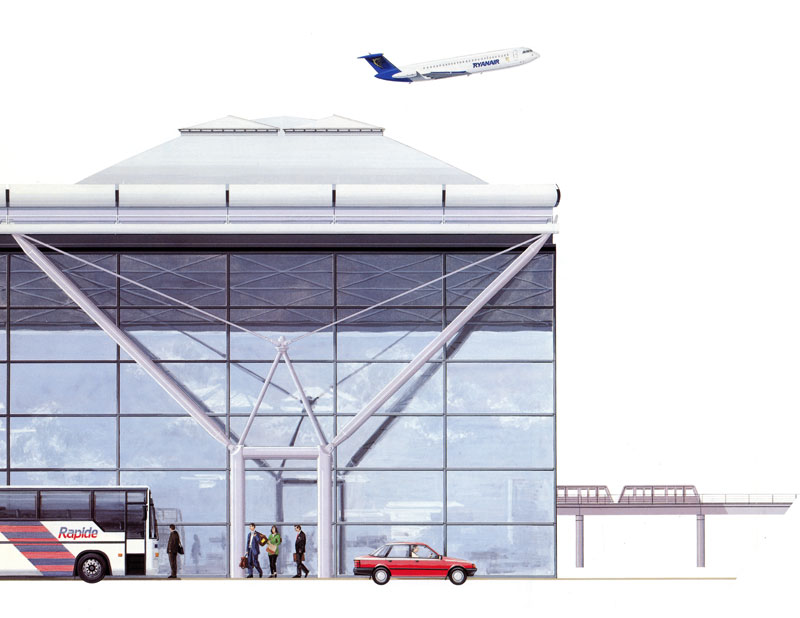
The terminal building of London's third airport is, in the words of its architect, Sir Norman Foster, 'elegantly anonymous'. Designed to be easy to use, to eliminate the hassle associated with most modern airports, Stansted has that same inspired balance between engineering and art that characterised the great Victorian railway stations. Like most of the buildings Foster designs, the terminal is basically a big shed. It is a flexible structure, designed to permit later modification in response to practical experience of its day-to-day operation. Foster consciously wanted to return to the simplicity and convenience of the early days of flying - the tent at the end of the runway, the impression of openness and accessibility. Of course, his romantic model has to allow for the complexities of air travel in the modern era - the busy crowds, the bureaucracies of boarding procedures, the demands of safety and security. Foster's customer-conscious design shows very clearly how travel is no longer governed entirely by economic or social necessity but, for its own sake, has become a part of our leisure culture. What factors make airport buildings seem more user-friendly?
Through chopping and changing, rebuilding and restructuring, some modern airports have ended up as labyrinthine traps for the unwary. Fearsome complications may be involved in getting from car park to check-in to departure lounge. Arriving travellers have to negotiate immigration, baggage reclaim and customs, and even when they finally make it to the concourse, getting out of the airport by bus, car or train adds to the scope for confusion. At Stansted, all public services are at one level, on a single concourse floor; passengers progress in a smooth, linear manner through each stage. Automatic tracked transit vehicles whisk them to and from the satellite buildings that serve their planes. The sense of calmness and order imposed by the 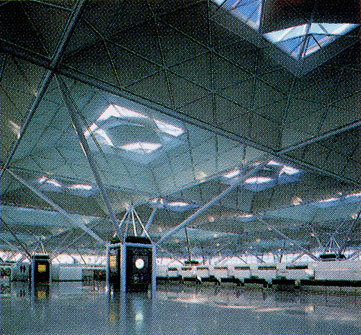 system - 'clarity' is the architect's word - is reinforced by its impact on the senses. At first glance, all colour seems to have been leached from the high, spacious interior by the diffused natural lighting coming from the roof and side walls. But then distinctive pockets of colour are seen, bright against the prevailing white and grey - information signs, airline logos above the flight desks, the fascias of the retail outlets, all things that, for different reasons, are meant to be seen. In a conventional 'shed' building, services such as heating and electrical equipment are placed on the roof; here they are beneath the concourse, in an 'undercroft' that also contains baggage handling, railway station and storage areas. This means the roof, a grid of elegant domes in steel and glass, intrudes less on to the landscape - the terminal building straddles a slight ridge - and can also be structurally lighter. It is stayed by 'trees' or clusters of columns that act as tension rods. The main structural feature of the terminal building, inside and out, these 'trees' also carry in their hollow core the distribution network for the airport's heating, lighting, ventilation and air-conditioning systems.